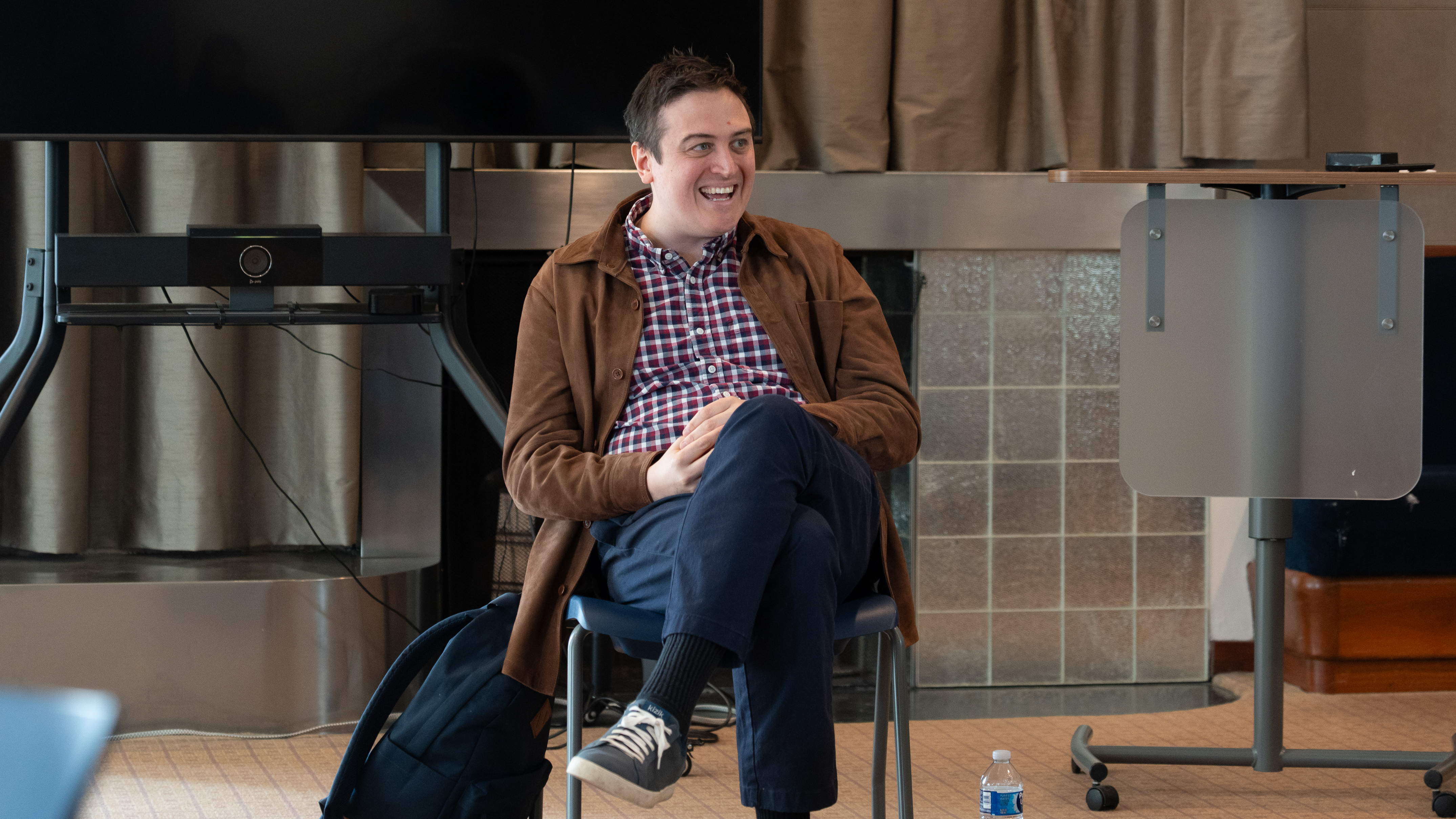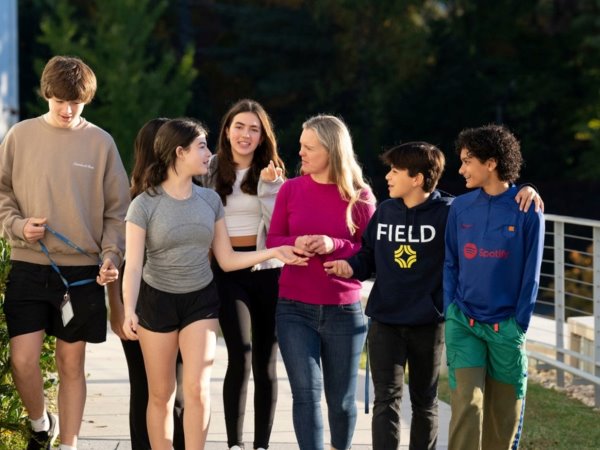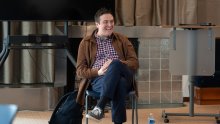
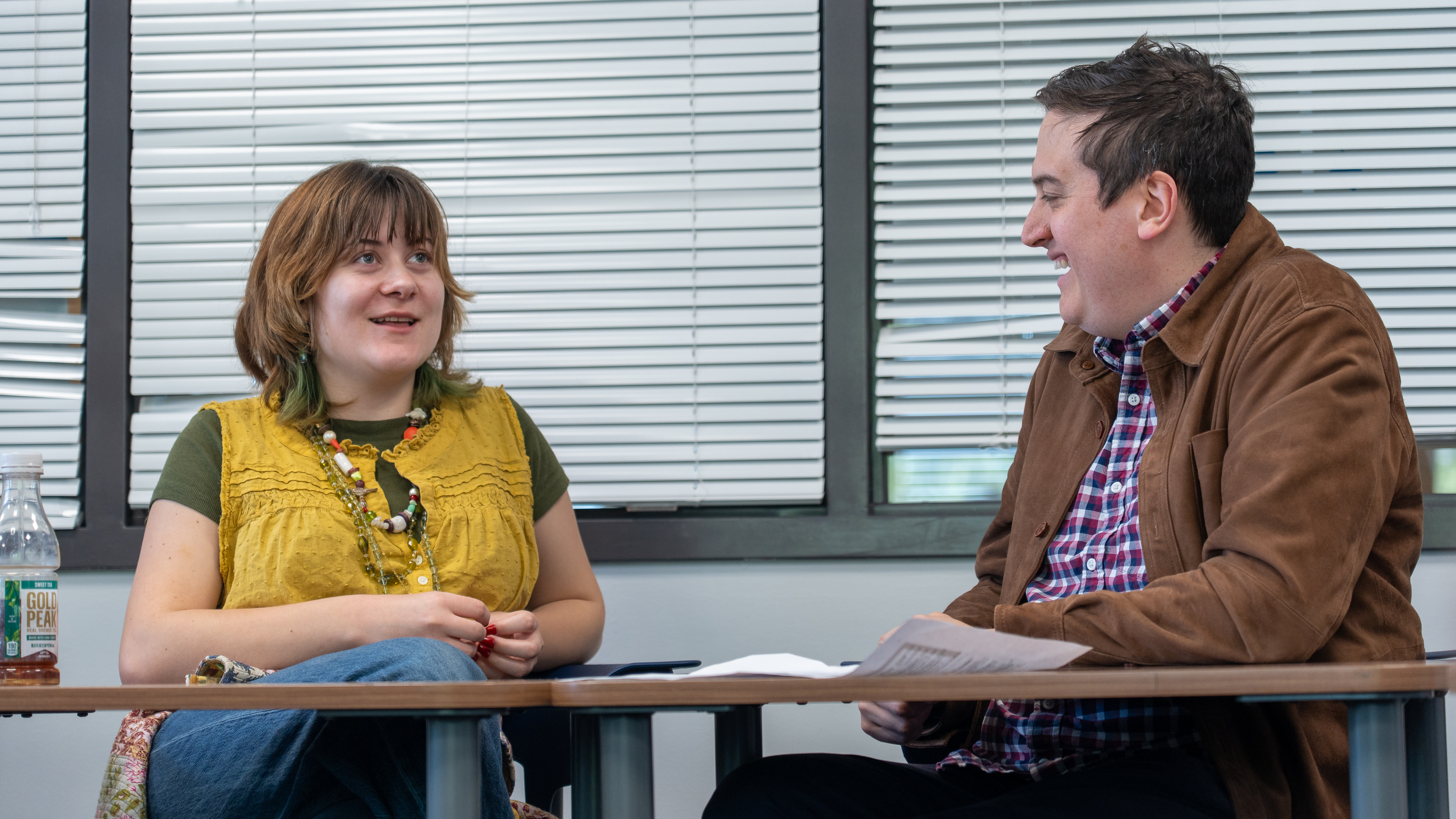
What does it mean to be a steward of the community? That is the question author and civic advocate Pete Davis explored with students during his visit to Field on Monday, April 20. Davis, a Falls Church, Virginia native, co-founder of the Democracy Policy Network, co-producer of the documentary “Join or Die,” and author of Dedicated: The Case for Commitment in an Age of Infinite Browsing, spent the day discussing what it means to participate in public life, while challenging students to move beyond the role of passive observers.
He urged students to think about the idea that “everything that exists tomorrow is going to be because a group of people, just like you, started working today to make it happen,” or what he referred to during a group exercise as the longest game ever invented. For example, seat belts exist because Ralph Nader spent years pressuring Congress, which resulted in the 1968 Highway Traffic Safety Act. The weekend exists because labor unions began demanding an eight-hour workday in 1884. Paid public restrooms? Although still common in Europe, they were banned in the U.S. because a group of high school students in Ohio founded the Committee to End Paid Toilets, published a newsletter called The Free Toilet Paper, and lobbied state legislatures until the machines disappeared.
Davis connected that type of individual and group commitment to the health of democracy itself, arguing that voting, while important, is just one small piece of what it means to be an active citizen.
Instead of thinking about democracy as something that happens, he argues that students should look at it as something that is lived daily, in schools, neighborhoods, and organizations. “The foundation of our democracy is not actually what's happening at the White House; it's what's happening in all of our neighborhoods and civic organizations all across the country. It's the clubs and the neighborhood and the relationships that actually make up democracy.”
During a lunch roundtable with student leaders, Davis dove a little deeper into the decline of American civic life. He referenced sociologist Robert Putnam's book Bowling Alone, to explain how civic life in America has eroded dramatically since the mid-twentieth century. The number of Americans who belong to zero community organizations has grown to about half of the country.
“The number one reason people become civically involved is that there is an opportunity to be civically involved…and that organization asks you to join,” he said.
When a student asked how to make a club more engaging, Davis responded by sharing that research shows inviting members to co-create and co-lead early is the biggest factor in whether they stay. Counterintuitively, making a club harder to join, not easier, tends to increase commitment. “People want to be challenged to do something more,” he said. “Tell an incoming member that by joining this club, you are going to fulfill a mission. People are driven by growth…people are driven by community, they want to be connected with other people, tap into all of those aspects in your club.”
“It was so cool to hear Pete's perspective on how our clubs at Field are the keystone to community! It was also nice to engage in a Q&A where we were able to learn how to improve our clubs so that we can build an even stronger community,” Sam ’29 said about the lunchtime conversation.
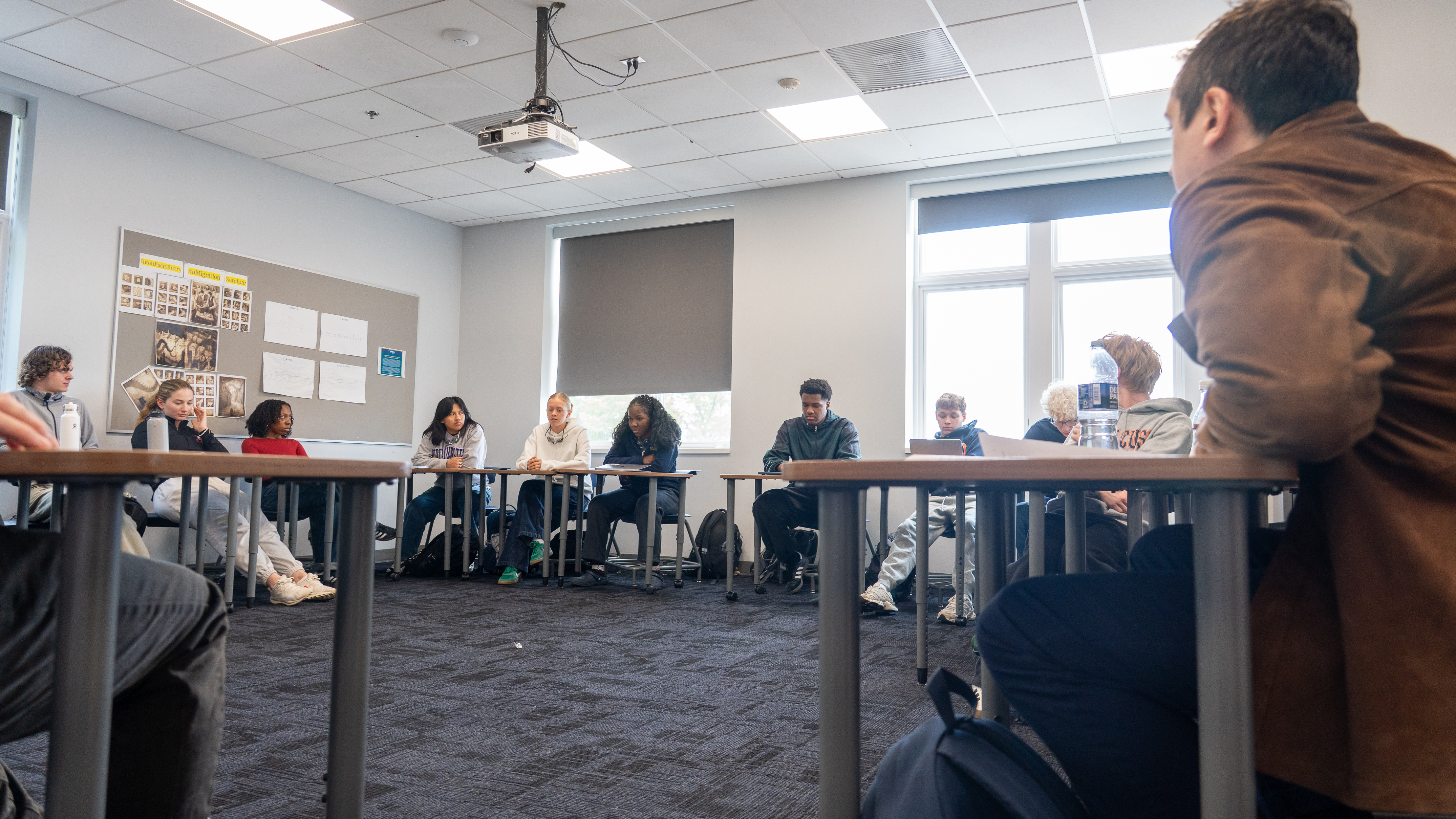
Davis’ final session of the day was with Bishop Walker’s African American Studies class, where students had just completed a summative assessment on neighborhoods and social movements. Some of their research included Shaw’s Black Broadway, the transformation of Arlington from one of the country's largest slave markets into a thriving African American community, and the role of the Abyssinian Baptist Church in Harlem as an unlikely hub for activism. Davis connected the students’ findings to a broader framework for understanding how social movements actually work.
He introduced them to the concept of “spade work,” a phrase from Civil Rights organizer Ella Baker, who used it to describe the unglamorous groundwork that precedes any public movement. Davis described how Rosa Parks’ act of resistance in 1955 on the bus was not a spontaneous moment but the culmination of years of community infrastructure-building, church committees, the local NAACP branch, coalitions of organizations that Martin Luther King, Jr. spent months mapping when he first arrived in Montgomery. “The metaphor I like using is that spark was able to catch fire because all these people had gathered all this tinder over the years,” he shared.
Vivian ’26 also pushed Davis to explain the difference between mobilizing and organizing, the fine line between effective disruption and counterproductive protest, and what high school students who want to make changes can actually do now. Davis shared that protests need specific targets and measurable goals. Raising awareness matters early, but strategy has to follow. Local organizing is what turns moments into movements.“Get involved with a local organization,” Davis said. “And even better, if that local organization is part of a coalition that federates nationally.”
Throughout his visit, Davis reiterated the same idea: the world is not on a fixed track. It is shaped, slowly and stubbornly, by people who decide to work on something together and keep showing up.
“I'm not going to stand up here this morning and tell you that you, as young people, are a magical solution to the world's problems," Davis said. “What I'm going to tell you is that you can be, if you choose to, and then follow up that choice with putting in the work.”
“His message helped me expand my thinking when it comes to the happiness everyone strives to achieve. I really enjoyed hearing his message on how America as a nation has been built on communities and how we need to keep these communities going strong,” Anna ’30 shared.