
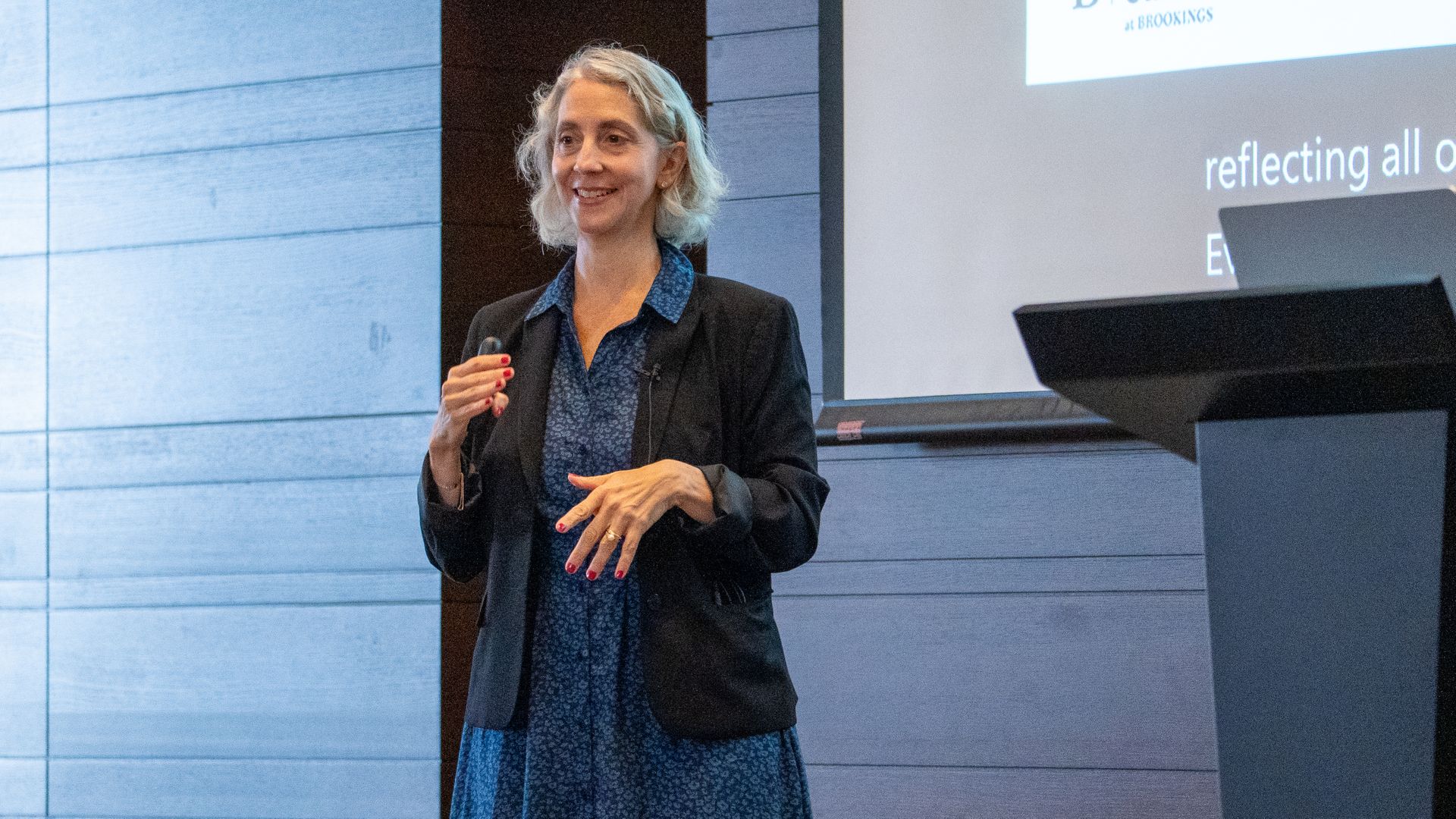
When AI can generate answers instantly, how do students continue to build the habits that make learning meaningful—curiosity, persistence, creativity, judgment, and self-knowledge? Director of the Center for Universal Education at the Brookings Institution, Rebecca Winthrop, visited students and faculty last week to answer that very question. Spearheading the Global Task Force on AI and education, Winthrop shared her research on AI, engagement, and educational equity in an all-school gathering. Then, in a Q&A gathering over lunch, she engaged students further in questions like "What’s the line between when AI is good versus bad?”
In the gathering, she began by holding discussion groups between students exploring questions like what excites you about AI, and what worries you. Students quickly expressed worries about the regulation, sustainability, the growing reliance on AI in general, and AI co-opting artists’ work and affecting people who work in creative fields. In addressing their concerns, Winthrop emphasized that AI is a tool: Generative AI “is reflecting all of humanity's smartness,” she said, not a replacement for human creativity. Comparatively, humans generate more diverse thoughts and creativity than AI. She also reminded students that AI doesn’t know the entirety of the human condition and misses nuance. “Your voice is unique and will continue to be so,” Winthrop said, reassuring students.
Despite students' concerns of AI “taking over,” Winthrop reminded students that critical thinking is necessary to use AI productively. Though AI seems to grow in use and prevalence, students can still control how engaged and motivated they are in their learning.
Winthrop proposed in the assembly the four modes of engagement for students to self-identify and use as tools to improve their participation. These modes are part of a framework she developed for her book, The Disengaged Teen. Winthrop posits that students can move fluidly throughout their day between four modes: resister, “I don’t want to do it;” passenger, “I’m here, but I’m coasting;” achiever, “I want to do well and meet expectations;” and explorer, “I’m curious, self-directed, and willing to keep going.”
She encouraged students to find their spark to get to explorer mode most of the time. Finding what sparks curiosity for each student is different. People tend to fall into different categories when it comes to motivation, such as doers, thinkers, creators, helpers, persuaders, or organizers. Winthrop offered some scenarios to help students identify where their motivation aligns with their interests and can spark more engagement. “So ultimately what we need is to try to be in explorer mode as much as possible, and exploring is really great in an AI world,” Winthrop said. In explorer mode, students are more likely to build habits like curiosity, persistence, creativity, judgment, and self-knowledge, which make learning meaningful.
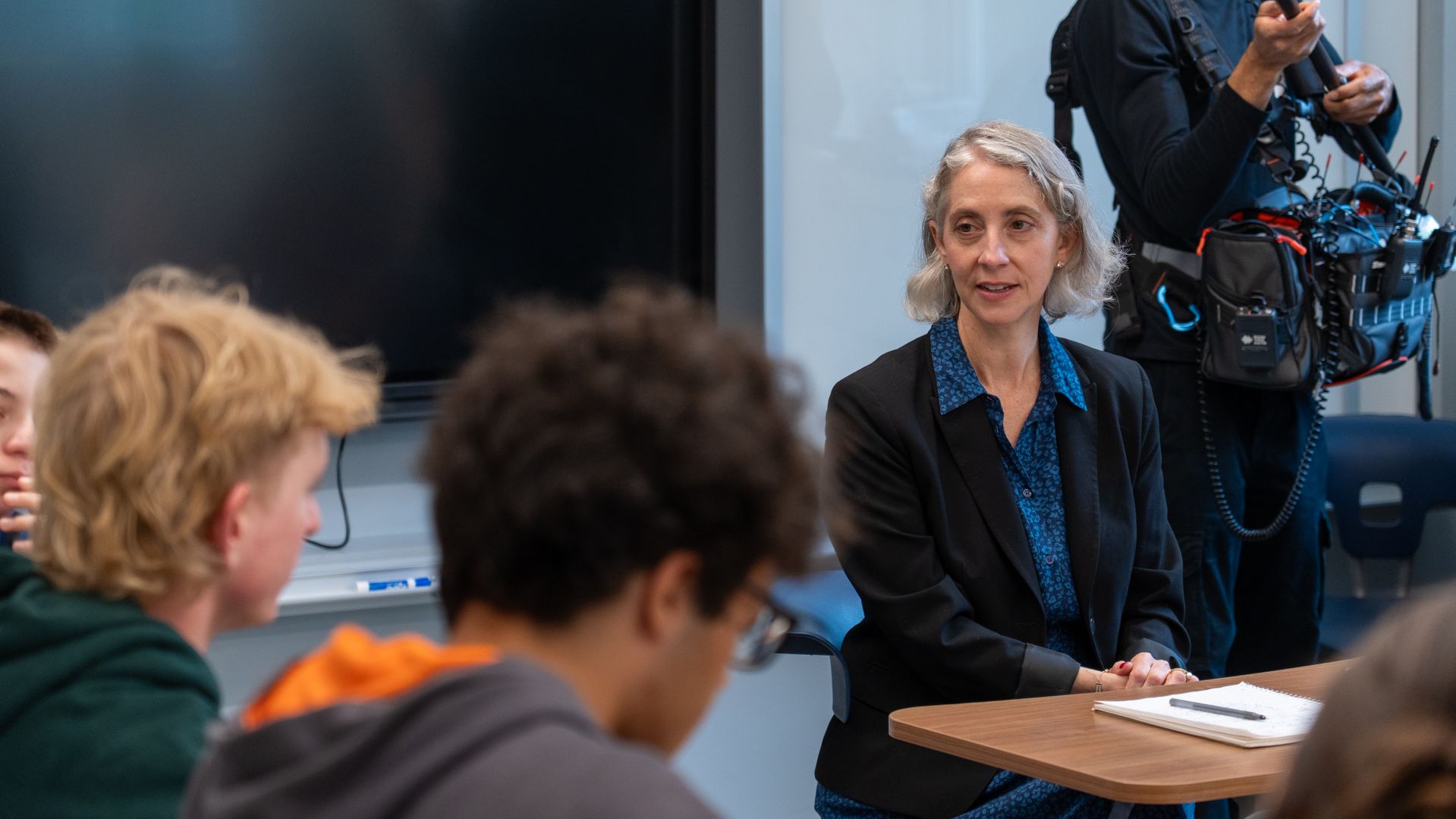
The Q&A took the ideas Winthrop shared in the assembly a little further. She asked students to contemplate good versus bad use of AI and a world in which AI was never developed. Students agreed that the overuse of AI has consequences for their development and future contributions beyond school. “I think AI makes it very easy not to have to develop those skills as strongly as they probably should be for a job or for college,” said Madeline ’28. The students reflected that while they need to embrace technological change, they also value learning to navigate challenges on their own. “There's a point where you're too reliant on it,” said Colin ’31. “I think it's a little bit out of hand when you start to become lazy, don't feel like doing it on your own,” Alex ’27 agreed.
Students reflected in their answers a desire to be challenged and wrestle with complex ideas. They agreed that overuse weakened critical thinking. Julia ’27 said simply, “I think AI should help with your thinking and not do your thinking for you.” They recognize that when the process is too easy, they lose the opportunity to build essential skills and discover their interests. Students offered practical ways that AI can aid their work while maintaining their agency, such as creating study guides, organizing information, and helping them get unstuck by posing questions.
Then, Winthrop asked, “If you could go back in time and live in a world before generative AI was invented, before ChatGPT was invented, would you do it?” Students were divided, with some saying that the bad outweighs the good for them. Despite others expressing their worries, some of those students claim they would still choose to live in a world with AI if it’s used properly. In their examples, they cited varied use of AI in research and emergency services as being beneficial for communities. And, “we can’t ignore every technological advancement,” concluded Jamie ’28.