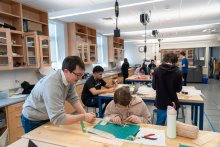
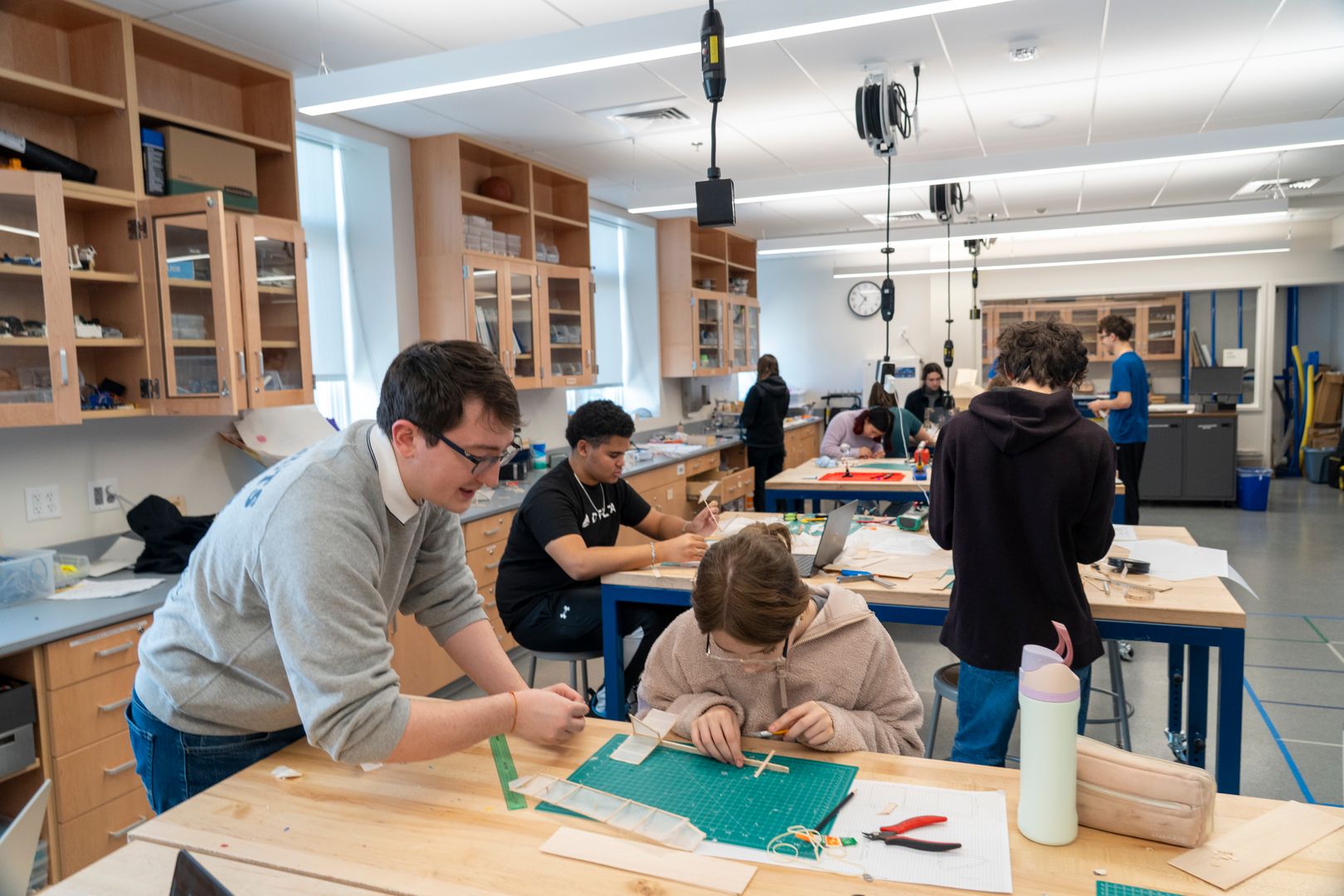
This year’s Engineering Intersession course, led by teachers Aidan Ferro and Madeline Holtz, adopted a Science Olympiad project titled The Wright Stuff, in which students were charged with building rubber-band–powered airplanes and testing how physics, precision, and patience come together in flight. The goal of this project, “really is the design-thinking process and the hands-on building experience,” says teacher Madeline Holtz, “working from an objective and going through the full long iterative process of trying something, seeing how it works out, learning from mistakes, collecting data, analyzing tests, and just really gradually and iteratively building towards a goal.”
The project requires students to design, build, and fly lightweight airplanes to maximize flight time under strict engineering constraints. As students cycled through the design-thinking process, progressing from sketches to test flights, the project transformed concepts such as lift, drag, and torque into tangible problems to be solved. “It's frustrating with all the failures, but it's good. I learned a lot about the process, what works, what doesn't, and the difference between lift and how that can create drag,” says Ryan ’27.
Students began with a simple question: how do you keep a plane in the air as long as possible? To address it, they operated under competition-style rules that limit wing size, stabilizer dimensions, and overall mass. With no minimum weight requirement for the rubber motor, success depended on efficiency and how thoughtfully each part of the plane was designed and assembled.
Every Wright Stuff airplane is made up of six key components, each demanding careful attention:
Students quickly learned that small adjustments, such as changing the wing’s camber or the balsa wood's density, can significantly alter a plane’s performance. “It uses everything on the X, Y, and Z axes. So just one little mistake can compromise your plane,” Seth ’26 confirms.
Beyond engineering skills, students practiced careful planning, precision, collaboration, and resilience, skills that transfer across disciplines and challenges. As Seth ’26 reflected on the experience, “It’s really about your thought process on what you can do to make it better.”
The Wright Stuff project embodies what The Field School values most: immersive learning that extends beyond the classroom and prepares students to embrace the problems they are presented with. Each failed flight was data. Each redesign was evidence of progress. And each successful launch represented students who had learned to think like engineers, to persist through frustration, and to transform constraints into creative opportunities.




.jpg&command_2=resize&height_2=85 "Students Design Legacy Posters for Civil Rights Journey")


