

What does justice mean in America? How has it changed over the past 70 years, and what are the system failures that need to be addressed?
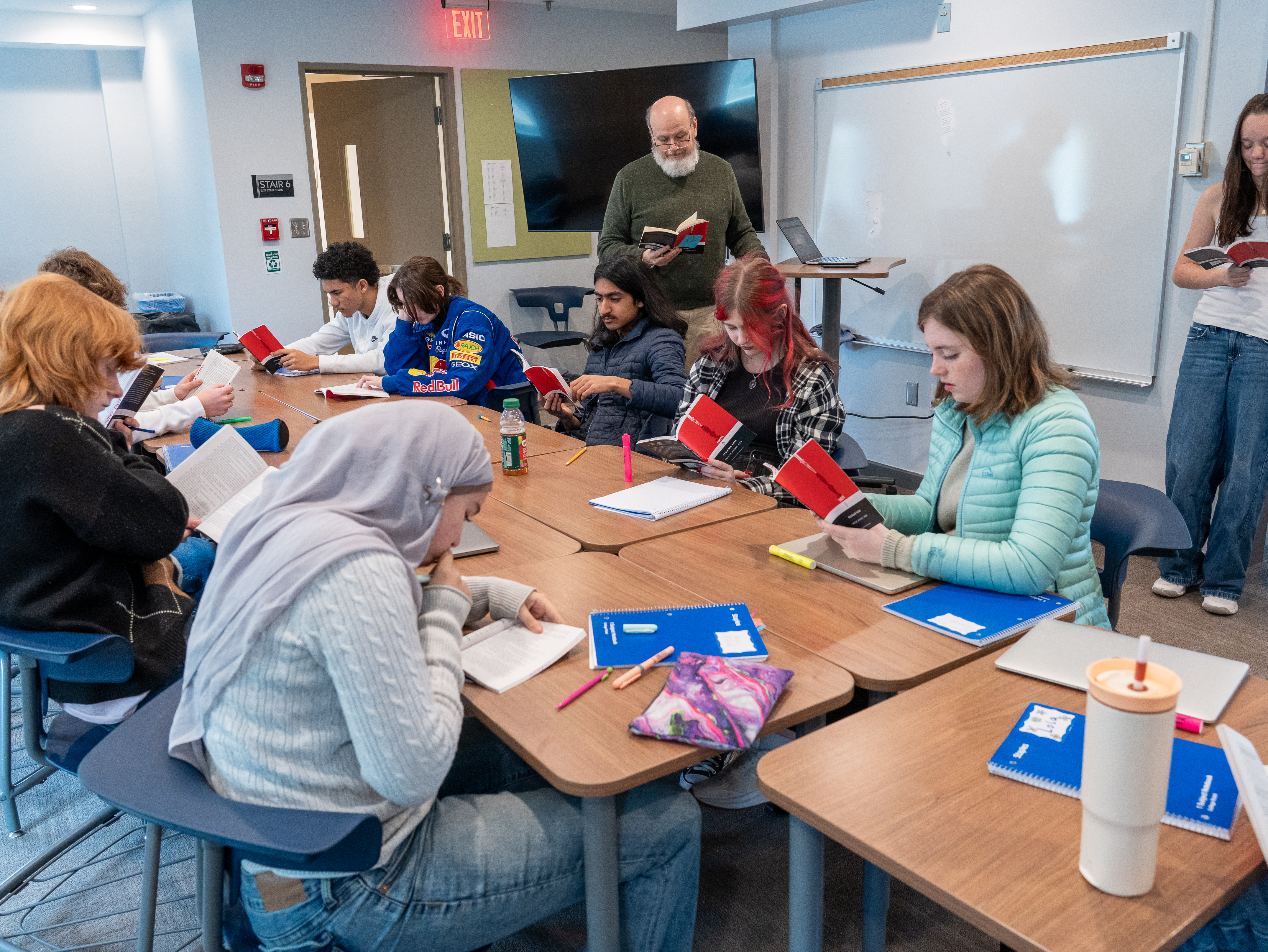
These are the questions that Field’s 11th-grade English students grappled with this fall as they immersed themselves in the American justice system through two powerful texts: Reginald Rose’s play 12 Angry Men and Bryan Stevenson’s memoir Just Mercy.
Through a series of table reads for 12 Angry Men, students brought the jury room to life, embodying the full range of jurors—from the prejudiced Juror #10 to the thoughtful and insistent Juror #8—as they deliberated the fate of a teenager accused of killing his father.
Concurrently, students read Just Mercy, which follows Stevenson's account of his work as a young lawyer defending prisoners on death row, and facilitated Socratic Seminars, leveraging original questions and careful annotations for deep discussion.
The pairing of texts is very intentional. By examining justice through different lenses—12 Angry Men, set in the 1950s, and Stevenson’s memoir, which spans the 80s through the early 2000s—students analyze how the American justice system has evolved, and they identify what problems persist.

"As our students are getting more mature in their thinking and their ability to do research, we want them to find areas of knowledge that might not seem to connect to something, but actually yield an even deeper understanding," explains English Department Chair Kevin Ford.
The texts also reveal uncomfortable truths that hit close to home. "Many of my students are shocked that the juvenile justice system is worse in the state of Pennsylvania…that's right next door," recalled English teacher John Cichello. “Much of Just Mercy is set in the Deep South, but Stevenson’s juvenile justice cases from Pennsylvania are pretty horrific.”
Despite the different settings and time periods, both texts expose flaws in our justice system. Nate ’27 said he found the contrast between the two texts valuable: "Just Mercy was a very real graphic text that continuously reminded me that these are real people and real experiences, whereas 12 Angry Men was more light-hearted. It was a breath of fresh air from the heavy text."
The unit centered on Socratic seminars, where students lead conversations about the texts. They came prepared with questions, observations, and evidence to support their interpretations.
“I was mostly taking notes and only occasionally did I feel like it was necessary to discuss a particular issue that didn’t come up,” John explained. “In most cases, they got to the key elements that I wanted them to.”
This student-led format allows for deeper, more organic exploration of themes like capital punishment, youth incarceration, and economic inequities. Kevin says one conversation in particular resonated with him. “One of my students, brilliantly, got really frustrated. He said, ‘I didn't realize in this country, a proper defense was a luxury item.’ And that really distilled this notion that, why is it that we have cases where people who have the ability to pay for robust defense on their own have much better outcomes than those who are relying on society? Are we willing to fund that?”
After spending a month with these texts, students created original podcasts as part of their summative assignment—examining one aspect of the American justice system. In groups, they researched, collected information, scripted, and produced their episodes.
“We wanted to challenge students to synthesize all of their new understandings and invite them to advocate for change,” Kevin explained. “But we also wanted that to be packaged in something that was authentic, real, and the kind of thing that is consumed in their real world.”
For many students, the format of this assignment was refreshing. “We write a lot of essays in all our classes, so being able to do something different is very interesting and exciting,” explained Lucile ’27. “And I think also the creative aspect of it was really fun.”
Groups selected issues that resonated with them the most, such as racial disparities in sentencing, underfunded public defense, youth incarceration, mental health in the justice system, and the impact of elected judges on fair trials.

What impressed Kevin and John the most was the students’ initiative in seeking their primary sources. Several groups independently organized interviews with professionals in the industry.
Nate’s group interviewed a D.C. Circuit Court judge, who offered new perspectives about racial disparities and biases in the justice system. “She had tons of new perspectives that we didn’t even think of,” Nate said.
Lucile’s group focused on public defenders—attorneys assigned to represent defendants who cannot afford private counsel. Through their research, they connected with Field alumna Jackie Prosky ’15, who works as a public defender in New York. “We talked to her on the phone for like 45 minutes and she just told us everything that she does and the different stories she had with clients,” Lucile said. “It was interesting because we were able to see the hands-on experience.”
The podcasts challenged students to propose solutions to the problems they identified.
“There is a moment when we’re pushing them not just to say, here’s the problem, but what’s the solution,” John explained.
For many students, the project shifted how they see the justice system. “We’re learning more about the criminal defense stuff and the persistent racism in the south, especially with high youth incarceration rates, high minority incarceration rates, compared to those of their white counterparts,” Nate shared.
Lucile gained a greater awareness of the humanity behind every case. “They’re more than just their case. And I think Brian Stevenson in particular does a great job at explaining that they have a history, they have a story. They've all been through different things, and you never really know. And so I think having empathy and being empathetic towards everyone just means a lot," she said.
The unit achieves something far more important than any grade—it ignites civic consciousness in our students. "For some of our students, this is a lifelong consideration, that they are, for the first time, feeling empowered, not just in their education, but in their place here in this country, to be able to say we see things we don't like, we want to be part of the advocacy to get somewhere better,” Kevin explained.





.jpg&command_2=resize&height_2=85 "Nate ’27 Wins Silver Medal in Scholastic Arts Competition")


.jpg&command_2=resize&height_2=85 "Students Design Legacy Posters for Civil Rights Journey")


