By Gil Gallagher
For the last year and a half, I have been building a robot with and for my son. In its current state, the robot can drive around the first floor of my house, display messages on a small screen, live-stream video so I can watch what it sees and drive it remotely, record sounds from the environment, and play back messages. I have no formal training in robotics. I learned most of the skills I'm now competent in while building this machine. And, I learned much of that by teaching myself, using an AI as my guide, my tutor, and my collaborator.
I tell you this not as a boast, but because it says something about how I believe learning works. And because I'm about to take on a new role at Field that is, at its core, about exactly that: how do we teach and learn to meet the moment we're in?
My first job was as a bicycle builder at a now-defunct bike shop in Tenleytown. I apprenticed alongside a grumpy, lifelong bike mechanic named Mitch. His profound belief was that, in order to learn the mechanical principles of the bicycle, you had to follow particular processes over and over and over again until you routinized them, before you could start doing any of the creative problem-solving that would inherently be necessary when working on bicycles that had been ridden by actual humans in the actual world. On my first day of that job, I didn’t finish building a single bicycle.
I remember the process exceedingly well because I did it hundreds of times. First, you slide the huge bike box down the narrow hall and slide it under the work stand. With the box cutter, you split the tape and pop the top open, folding back the flaps so you can see the bicycle nestled between cardboard or foam tubes wrapping the sensitive parts. You find the saddle and seatpost, slather them with grease, put the post into the seat tube, and clamp the quick-release skewer. Pushing upward from the underside of the saddle, you lift the whole bike out of the box and clamp it in the repair stand’s ratcheting jaws. You reach down for the small parts box: reflectors, pedals, and occasionally some annoying accessories that need to be attached.
Next, you cut the zip ties: the one holding the front wheel to the frame, the one holding the handlebar assembly to the top tube, and the one holding the cranks to the chain stays. You thread the quick-release skewers through the front wheel. You pop the fork protector out, orient the fork so it’s facing forward, and install the stem and handlebars. Make sure all the cable housings are in the right stops. You thread the pedals on, remembering that the drive-side pedal is reverse threaded. You remove all the foam padding and cardboard tubes and toss them into the box underneath to catch all the trash you produce while you build. You attach reflectors, tighten all the bolts, and inflate the tires. When you get good enough, you’re allowed to run through the gears and adjust the derailleur cable tension, realign the brake pads, and check the tension on the brake levers. Bikes rarely work perfectly with the factory setups. Over the years, you come to notice that certain brands have certain eccentricities, brake pads toed inappropriately, causing squealing; derailleurs tuned for a different altitude than the one you’d be riding in.
I worked on bikes throughout my youth, and I think of my youth as lasting well into my twenties. Over the years, I got very, very good at working with these machines, which are both simple and complex. I learned dropout and fork alignment, how to retap stripped threads, and install a helicoil. On two occasions, I took apart and successfully reassembled 8-speed internal hubs with their complex constellations of planetary gears. I learned to true wheels and eventually became a certified master wheelbuilder. In college, I built wheels for a couple of local mountain bike heroes, and I’m proud to say that a set of my wheels won the 24 Hours of Canaan race in the late nineties. Wheelbuilding is precise and meticulous work, part art, part science. I have known wheelbuilders who use spoke tensionometers to calibrate the tension on every spoke to the decimal. I have also known wheelbuilders so skilled that they can strike the spokes with a tuning fork and intuit the tension from the tones.
I have been pursuing the question of how we develop mastery for my entire life. In college, I cycled through computer science, digital design, and anthropology before landing on English and comparative literature, then went on to get a master’s in fine arts and creative writing. For years, I approached the writing of poetry the way I had always approached the building of machines: there were formal and structural challenges that appealed to me, creative constraints that allowed me to build things I might never have thought of otherwise.
Years later, in my basement, building a robot for my son, I found the same thing was true. The robot taught me that what Mitch gave me, the patience for process, the willingness to try and try and try again, the discipline of learning a thing correctly before trying to be clever about it, translates. Whether you’re working with steel cable or signal wire, with spoke tension or servo motors, the underlying principles hold: how do you support load with structure, and how do you transfer energy?
I didn’t know it yet, but I was building a theory and a mental mode.
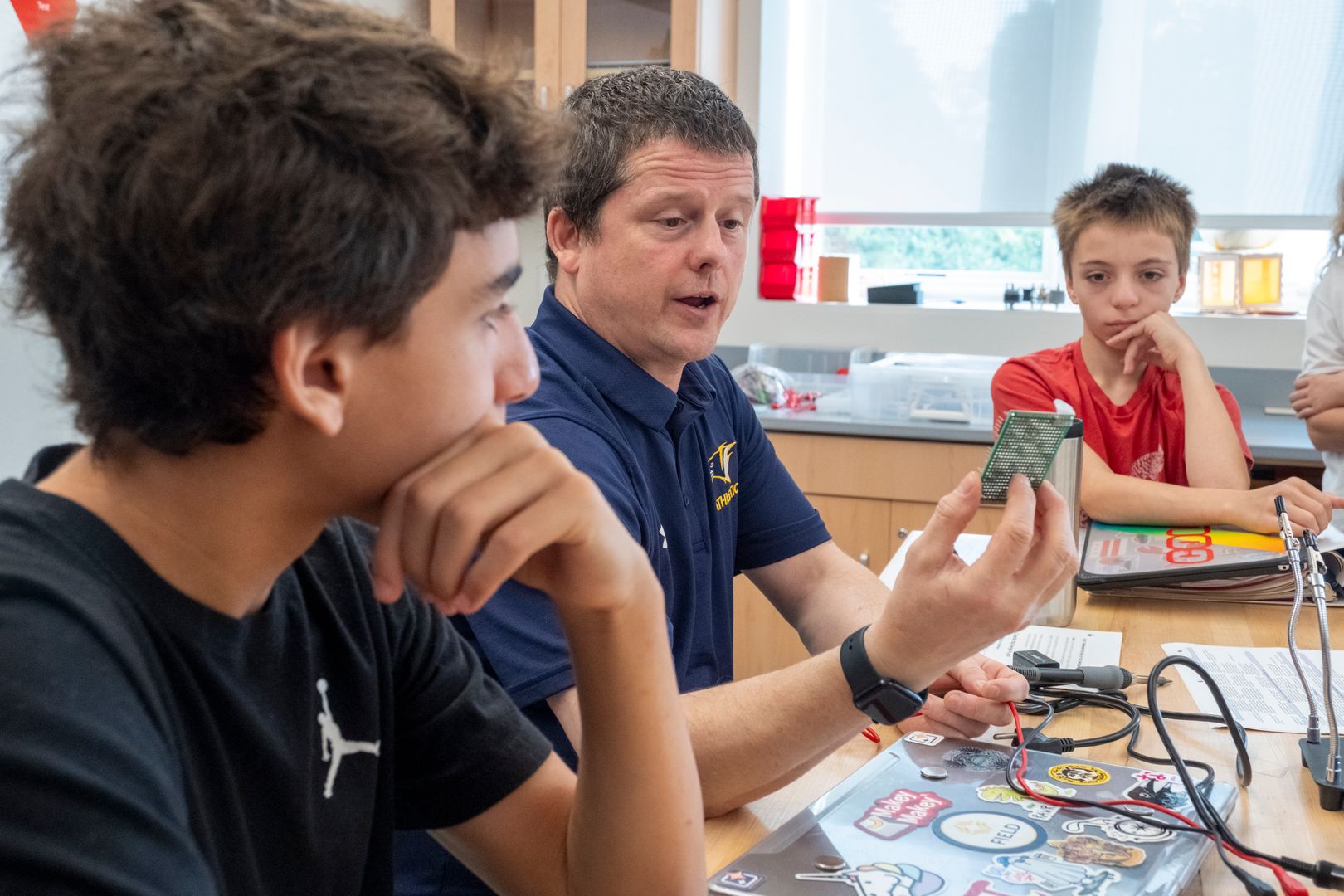
I looked up from my desk one afternoon and scanned the room. Colin and Evan were at the laser cutter, fabricating props for next week’s theater production. Lily and Caitlin had just finished showing their clock stool to Madison, a semester’s worth of design thinking made physical, and were now working on a logo to embed in its base. Luca was puzzling over how to slice the 3D model of a table he’d designed for a communications director’s office. Sylvie was on her third prototype of a felt pencil case she was making for a friend. Will was resoldering a lamp, a second version of a project he’d completed earlier in the year, because the first version needed further work. Carter was running through prototype after prototype of a small game he was designing for students to use in one of our common spaces.
It was noisy and messy. I kept having to remind kids to get back to their designated zones. And I thought: we have reached the point in the year, where they realize they are a small army of kids who know how to make things.
That’s what I’ve been trying to build.
As Director of THINK Studio, I get to build the conditions for that to happen at scale.
I’m sitting in my office on a gray Monday. Outside the window, an enormous drill rig occupies what used to be the turf field, boring 600+ feet down for geothermal wells. They’ve just finished grading the new practice field, and I’ve been watching in something like awe as workers construct the massive retaining wall that will hold back the hillside the THINK Studio building will rise from.
It’s a strange and exciting moment to watch a building take shape that will house a program I think I’ve been designing, in iterations, for the last twenty years. In my early years in the classroom, I played around with what we called multi-genre projects, a fancy way of asking students to show their thinking in multiple ways, through multiple forms. There’s a lot of power in Project-Based Learning as a framework, but there is also something limiting about any given framework. For many people, the phrase still evokes images of a diorama, and while I see real value in creating physical, digital, and mental models of ideas and phenomena, poster boards and dioramas can feel a little too much like the contrivances of school. Too easily “finished.”
Central to my work over the last twenty years has been trying to bring down the walls between the classroom and the world. That often meant asking kids to write in math class, or do math in English class. To make things that had to work in the actual world, for actual people.
At its core, THINK Studio is not about a building, a set of classrooms, or any new technology. It’s about thinking, about pushing the possibilities of what thought and creation can look like when you give adolescents real problems and the tools to solve them. Adolescents are uniquely poised to do that kind of pushing. I’ve watched them do it. I’ve watched a kid on her third felt prototype, a kid resoldering a lamp he already finished once, a kid iterating a small game for his peers, and I’ve thought: this is what Mitch was teaching me, all those years ago in Tenleytown.
You learn the process. You do it again. And then you start to make something that’s yours.
That’s what THINK Studio is designed to be: not a single moment of revelation, but a place, and a practice, where students return, again and again, over the arc of their years at Field. A place where thinking and making are inseparable, where depth is the expectation and iteration is the method. Where students discover not just that they can build things, but that they are people who think deeply and make things from those depths.