Written by Gil Gallagher, Middle School Director
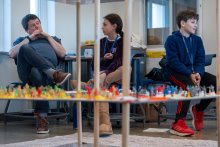
At our middle school meeting after Intersession, I asked a few students from each grade to share their experiences. I'd spent most of Intersession in a single classroom with our sixth graders playing the World Peace Game, so my view was limited. Listening to these students talk about their experiences across all three grades, I saw something I hadn't fully grasped before: how successfully we had intentionally built the middle school Intersession experience. We have spent the last few years implementing a stepped approach to provide continuity and to help students experience deeper learning in these courses. It was gratifying to see meaningful work emerge alongside their reflections.
The World Peace Game is a simulation that drops our sixth graders into a world facing multiple interconnected crises—everything from oil disasters to territorial disputes to economic collapse. The game pushes players to see themselves and their peers as powerful change agents capable of tackling big, complex problems. But really, it's about learning interdependence. These students are preparing to spend seven years together, and watching them navigate the complexities of the game galvanizes them as a group.
Here's what I didn't expect: how hard it would be for me as the facilitator to resist my own impulse to "help." I watched students write treaties I couldn't see the purpose of, make deals that seemed ill-advised, and ignore what appeared to be urgent crises. My adult mind raced ahead to the problems I would solve and in which order. For instance, rising sea levels went unaddressed for much of the game while students invested in weather balloons, built resorts, and tried to rebuild their economies. I caught myself debating whether to direct them toward what I saw as more pressing issues.
And then, quietly, I kicked myself for trying to “solve” the problems for them or help them too much.
Because of course, they did save the simulated world that I created for them—and they did it their way. The students role-playing Secretary-General of the UN and the President of the World Bank worked together with the student leader of the game, a.k.a. the weather deity, to make complex decisions. Students demonstrated competence and confidence as they learned to handle complexity, ambiguity, and high stakes by leaning on each other.
Where the World Peace Game asks students to engage with breadth—many problems, many perspectives, many crises—the seventh-grade Intersession course narrows the focus dramatically. Students spend their time thinking deeply and interdisciplinarily about a single critical resource: water.
Seventh graders investigate current drought conditions across the United States, learning how intensity levels—from abnormally dry to exceptional drought—impact agriculture, water supplies, and ecosystems in different regions. They analyze the hidden water footprints of food production, discovering that a single meal can require hundreds of gallons of water. Eight ounces of pork equals 330 gallons. The same amount of carrots is just 7.4 gallons.
The interdisciplinary nature of this work leverages our seventh graders' deepening academic skills and their growing capacity for nuanced thinking. They make connections across subjects like state agriculture (which in California uses 80% of the state’s water supply), ecology, mathematics, and social responsibility. Their goal is to educate others about the profound implications of the food choices we make, especially when snowpack levels, reservoir storage, and surface water supplies become critical for communities and ecosystems' survival.
But water isn't just data and statistics. Students also select from a curated list of novels to explore how water and ecology shape the human experience. Some titles tackle the subject head-on: Neal and Jarrod Shusterman's Dry imagines a water crisis that makes the drought data students have studied feel terrifyingly personal, while Diana McCaulay's Gone to Drift and Katherine Applegate's Odder explore our relationship with ocean ecosystems and the creatures that depend on them. Others—like Amy Sarig King's Me and Marjan Gardens and Louis Sachar's Fuzzy Mud—broaden the lens to examine environmentalism more widely, asking students to consider the unintended consequences of how we treat the natural world. And Jules Verne's Twenty Thousand Leagues Under the Sea reminds students that humans have been grappling with our fascination with and dependence on water for a very long time. Across these stories, students encounter a common thread: water connects everything—communities, ecosystems, food systems, and daily life—and our choices about how we interact with it have consequences far beyond what we can see. The combination of analytical work and narrative understanding gives students a more complete picture than either could provide alone.
The groundwork laid in sixth grade and the depth of thinking developed in seventh grade come to fruition in our eighth-grade service-learning trip to Costa Rica. Students don't just learn about environmental problems or study potential solutions—they work alongside marine biologists at the only coral restoration lab in Central America, seeing firsthand how coral fragments are grown, cleaned, and replanted on reefs.
In past years, students have returned from Costa Rica to participate in a Model UN simulation focused on coral reef restoration and the UN's 14th Sustainable Development Goal: Life Below Water. They research and represent different countries—some with obvious connections to coral reefs like Australia and the Philippines, others with less visible relationships like Egypt's Red Sea systems or Palau's marine protection initiatives. They propose real solutions: global funding for coral labs, collaborative transplant programs, tourism zoning strategies, and clean-energy investments.
What's remarkable in this process is watching students form blocs not along friendship lines but based on shared environmental, economic, and geographic interests. As eighth-graders, teaming with people outside their friend groups isn't always easy. But they rose to the occasion. As one student reflected after a previous year's simulation: “It was cool learning about a country I knew nothing about. Now I care what happens to it.”
That's the goal of these three years—moving students from understanding problems to actually caring about solutions and the people impacted.
From sixth grade's emphasis on interdependence and collaboration, through seventh grade's focused expertise on a single complex issue, to eighth grade's real-world application and advocacy, our Intersession program builds students who don't just understand global problems but feel genuinely empowered to address them.
The sixth grader who learns to trust their classmates to solve the oil crisis becomes the seventh grader investigating water footprints, the eighth grader working with marine biologists, and then representing nations to propose policy solutions. They learn that complex problems can be – and often must be – addressed collaboratively, that true understanding requires us to look through multiple lenses, and that our students are more than capable of engaging meaningfully with the world beyond our campus.



.jpg&command_2=resize&height_2=85 "Graphing Quilt Blocks in Middle School Math")


