By Emily Bliss, Middle School English Teacher
It was exactly the kind of juicy, creative teaching challenge that attracted me to Field: I needed to design and lead a joyful, literature-based English class that would fit seamlessly into a science-themed Intersession program.
Intersession is one of Field’s distinctive and exciting features. Every school year, for two weeks, students and faculty pause their usual classes and schedules for a deep dive into a topic. This past year, during Intersession, student groups learned about the Civil Rights Movement through a tour of the American South, sharpened their wilderness survival skills in the forest, experienced culture and geography on a trip to Costa Rica, designed and created their own board games, and learned the science of flight to build model airplanes.
I was thrilled when I got my Intersession assignment: a deep dive into water ecology with the ever-energetic, voluble, playful, and creative seventh graders. But this English teacher—who just might have failed a college chemistry exam after drawing a diagram of a leprechaun mole finding a pot of gold instead of using Avogadro’s number to calculate moles of gold—would need to leave classes that featured water wheel construction, pollution data analysis, and marine mammal study to my math and science department colleagues.
For weeks, I mulled over what my water-ecology English class could look like. And then I had my first round of parent-teacher conferences. Over and over, I heard the same thing from parents: I want my child to read more for pleasure. I want my child to have fuller access to the joys of reading novels.
I kept thinking about those words. And about Field’s English department, which I joined this year because of its philosophical emphasis on joyful reading and creative engagement with literature.
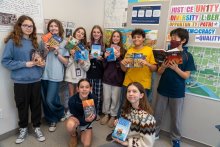
And that is when I knew what to do. My English class was going to be a screen-free immersion in water-themed fiction. For an hour every day, the seventh graders and I would swim through imaginary worlds.
I plunged into compiling a list of middle-grade novels with themes related to water and the environment. I scoured library book lists, rosters of award winners and nominees, suggestions published by book stores and publishing houses, and reads recommended by my favorite children’s literature bloggers. I made a long list of finalists, and then I started my own reading campaign. My own children and I spent every commute listening to water-themed middle-grade audiobooks, and we had many “driveway moments” finishing a particularly action-packed scene before we went inside to eat dinner. I ultimately chose books that were engaging and that would appeal to a wide range of readerly appetites, abilities, and sensibilities. There were books about mermaids and talking dolphins, about self-aware otters that spoke in verse, about plastic-eating creek creatures, about spies on cruise ships, and about dystopian water shortages. My goal was for every seventh grader to find at least one book—and hopefully more—that appealed to them.
For the first week of Intersession, all we did together was read. I banned screens, music, and other distractions entirely from the room. I helped each student choose a book I thought they would love, one that would completely capture their distinct imaginations and appeal to their unique literary palettes.
Field seventh graders surpassed my highest expectations. My goal was for every student to read one book during the first week. Not only did we meet that goal, but many students read two, three, or four books. Often, during our book club, the classroom was utterly silent. (If you have spent any time with middle school students, you know this is highly unusual.) At the beginning of one of our reading sessions, I heard a student say, “I love this.” Another said, “This is my jam.” And, poignantly, another said, “I wish I’d grown up before cell phones so it could be like this all the time.” That last comment left me thinking about our responsibility as adults to create spaces free of addictive and distracting technology so that young people can have this kind of experience much more frequently.
After the first week of Intersession, the seventh graders each got to design and execute a project that connected to what they had learned. Many students chose to create projects in response to the books they read: board games based on novels, posters of imagined film adaptations, analytical essays, dioramas of underwater settings, scripts of sequels, portraits of characters, book trailers, short stories, and poetry collections. The work was creative and lively —it showcased the real joy of reading books and escaping to a rich, enthralling, imaginary place.
I finished Intersession thinking about ways to bring elements of our water-themed book club into my seventh-grade English class. My teaching partner, Elizabeth Weaver, and I recently found this opportunity.
Two weeks before spring break, we gave every seventh grader When We Flew Away by Alice Hoffman and told our classes we were embarking on another Intersession-style reading sprint. This beautiful and haunting work of historical fiction depicts Anne Frank’s life before her time in hiding, and Elizabeth and I decided to use the book to contextualize Anne Frank’s diary. We devoted class time to reading it so we could finish it before the break; as soon as students opened the book, my seventh-grade English classroom fell into silence.
After my experience during Intersession, I knew to expect that many seventh graders would finish it quickly. I was ready with a mini-library of high-quality middle-grade historical fiction about World War II and the Holocaust.
Sure enough, the day after I handed out the book, two students came up to me during lunch.
“Emily, I finished the book.”
“Me too.”
“Do you have more books to feed us?”
“Yes,” I said. And I put another book in each seventh grader’s hands.




.jpg&command_2=resize&height_2=85 "Graphing Quilt Blocks in Middle School Math")


