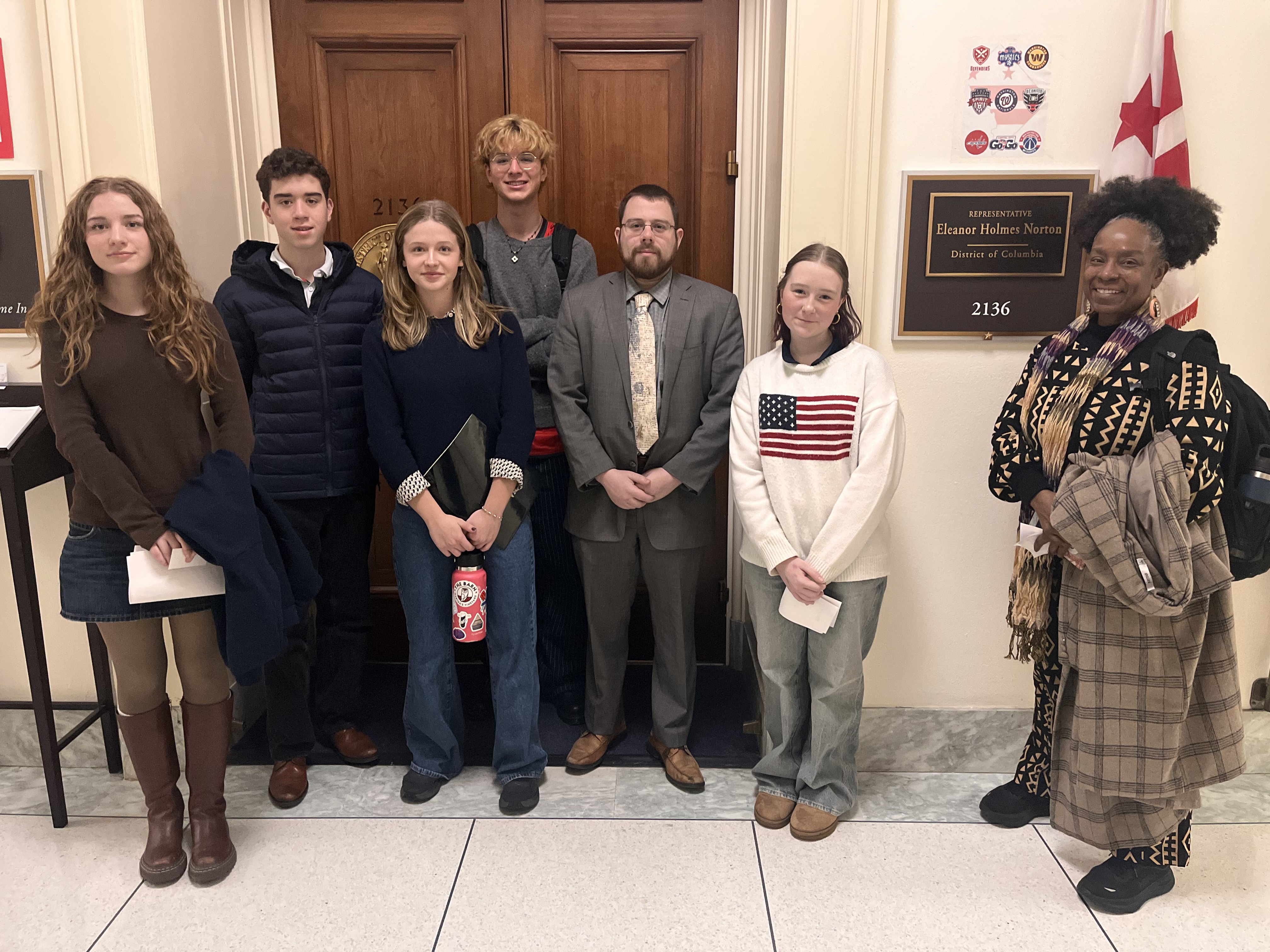
When members of Field’s Democracy Club walked into Congresswoman Eleanor Holmes Norton’s office on Capitol Hill last month, they came prepared to advocate on the issue of ICE enforcement in DC. “I thought I went into it kind of hoping it would be me speaking with a representative about something I wanted to happen,” said Thomas ’28. “But it was not that. It was very educational. It was very interesting, and I learned more about the process of DC’s involvement with the federal government.”
Lacking State’s rights, like Maryland and Virginia, the District operates more under federal laws. Students learned that their voices are more powerful and can more likely affect change on a local level through advocating with the mayor, their councilmembers, and even their Advisory Neighborhood Commissions.
“What we learned is that really the office there couldn’t really do anything. They’re more linked to the national government instead of our local government,” said Jonah ’28. “So what we need to do is talk to Mayor Bowser’s office next.”
The realization that the DC government is complex, layered, and requires persistence has become foundational to the Democracy Club’s work. What began as a visit to advocate on one issue became a broader lesson in civic structure, responsibility, and the power of local engagement.
The Democracy Club was formed to offer students the opportunity to explore civic life as a lived experience. Led by students, with teacher Kimberley Yates PhD as a guide, early meetings focused on building foundational civic knowledge: understanding constitutional rights, examining how different levels of government operate, and discussing how policies shape daily life in the District.
“I think the first thing we really talked about was the involvement of ICE in DC; what are our rights, and the Sixth Amendment, and how ICE on a national level was unconstitutional,” said Eileen ’28. “That was really interesting to start with that civic education.”
For many students, the trip to Congresswoman Norton’s office was the first time they saw how the structure of government shapes what is possible and how meaningful change often requires starting closer to home. Eileen noted that the experience reinforced a broader lesson: young people have to take the initiative to do their own research, because the institutions they’re trying to influence can’t always do it for them.
Beyond learning how government functions, Democracy Club members are developing the habits of informed citizenship. Students discuss current events, examine different perspectives, and practice evaluating sources critically.
“I really try to make a huge point at being really knowledgeable about what’s going on,” said Vivian ’26, a politically active student who joined the discussion. “Reading reputable sources. And also, I think it’s really valuable to read what political sides you don’t necessarily align with.”
Thomas ’28 echoed that call for independent inquiry and for people to build their knowledge about government. “We should all look up what the Department of Justice does, really,” he said. “That’s all publicly available information.” The idea, he explained, is to move beyond simply being told what’s happening and toward genuinely understanding the institutions shaping the news and their functions.
Through experiences like their visit to Capitol Hill, students are learning that democracy requires participation, persistence, and the willingness to hold ambiguity and to be patient as change makers.
“I think we should raise awareness—not just about ICE specifically, but about interacting with your representatives,” Thomas ’28 said. “The fact that you can ask your representatives for a meeting… I feel like it’s not a really available fact.”
Carolina ’28 agreed and put it simply: “What we can do is speak out about it and inform people.”
For many Democracy Club members, civic engagement feels especially urgent because the ability to vote and the emerging civic responsibility of adulthood are close. To move their advocacy work forward, members are seeking a meeting with DC Mayor Muriel Bowser’s office, creating informational materials for their peers, and helping other students understand how to engage with their representatives.
At Field, a sense of ownership is central to the educational experience. By engaging directly with civic institutions, asking questions, and taking initiative, students are developing the knowledge, confidence, and agency to shape their communities.
“It’s cool to talk to your representatives,” Thomas ’28 said. “It’s cool to know about your government.”




.jpg&command_2=resize&height_2=85 "Nate ’27 Wins Silver Medal in Scholastic Arts Competition")


.jpg&command_2=resize&height_2=85 "Students Design Legacy Posters for Civil Rights Journey")


